

Real Users, Real Feedback: Community Insights on AI Performance
Discovering the Differences: My Journey into AI
As a blogger familiar with various versions of ChatGPT, I decided to dive deep into the differences between ChatGPT-4 and ChatGPT-4 Turbo, which some people call “ChatGPT-4o.” At first, it was tough to spot clear distinctions just by using them myself. Knowing that my own experience might be limited, I reached out to a wider community.
I gathered thoughts from other AI enthusiasts and read what many users said online. It turns out, ChatGPT-4 Turbo is often praised for being more accurate and capable than its predecessor. However, I knew I needed more than just opinions for a real comparison.
SUMMRY:
| Section | Summary |
|---|---|
| Community Insights | Users praise GPT-4o (ChatGPT-4 Turbo) for higher accuracy, faster responses, and improved handling of complex tasks compared to GPT-4. |
| Hands-On Testing | Direct comparison of both models across topics provided measurable data showing GPT-4o’s better performance in speed, multitasking, and context management. |
| Creative Performance | GPT-4o produces more polished and emotionally resonant outputs, with smoother flow, richer imagery, and better thematic clarity than GPT-4. |
| Analytical Depth | GPT-4o offers concise, structured, and practical insights; GPT-4 gives deeper, reflective analysis suitable for philosophical and technical queries. |
| Scientific & Philosophical Tasks | GPT-4o simplifies complex processes and makes explanations accessible; GPT-4 provides detailed, technical, and in-depth responses. |
| Canvas Feature | GPT-4o introduces Canvas, a visual workspace for collaborative editing, real-time feedback, and iterative tasks, unlike GPT-4’s text-based interface. |
| Key Advantages of GPT-4o | Faster, more accurate, better at multitasking, improved multilingual handling, fewer errors, maintains context over long dialogues. |
| Limitations & Free Access | Free users can use GPT-4o with up to 10 messages per day; paid subscriptions offer higher limits and unrestricted access. |
Testing the Tech: A Hands-On Approach:
To get to the bottom of things, I set up a series of tests, asking both AI models specific questions across different topics. This hands-on testing let me directly compare their performance, giving me solid, quantifiable data to work with.
Bringing It All Together: This Blog Post
This blog post mixes what I learned from the AI community with my own testing results. It’s designed to be an easy-to-follow guide that highlights the subtle but important differences between ChatGPT-4 and ChatGPT-4 Turbo. Online discussions have shown that key areas like response speed, understanding context, handling multiple languages, customization, and how well they integrate into businesses are all important. Issues like ethical considerations and how they manage tricky questions also stand out.
I’ve put together this review to shine a light on these areas, offering a clear and simple overview of what each version offers. By combining real user experiences with practical tests, this post aims to provide a clear and engaging comparison, helping you understand the evolving landscape of AI technology.
Assessing AI Performance: How GPT-4o Improves on GPT-4’s Capabilities
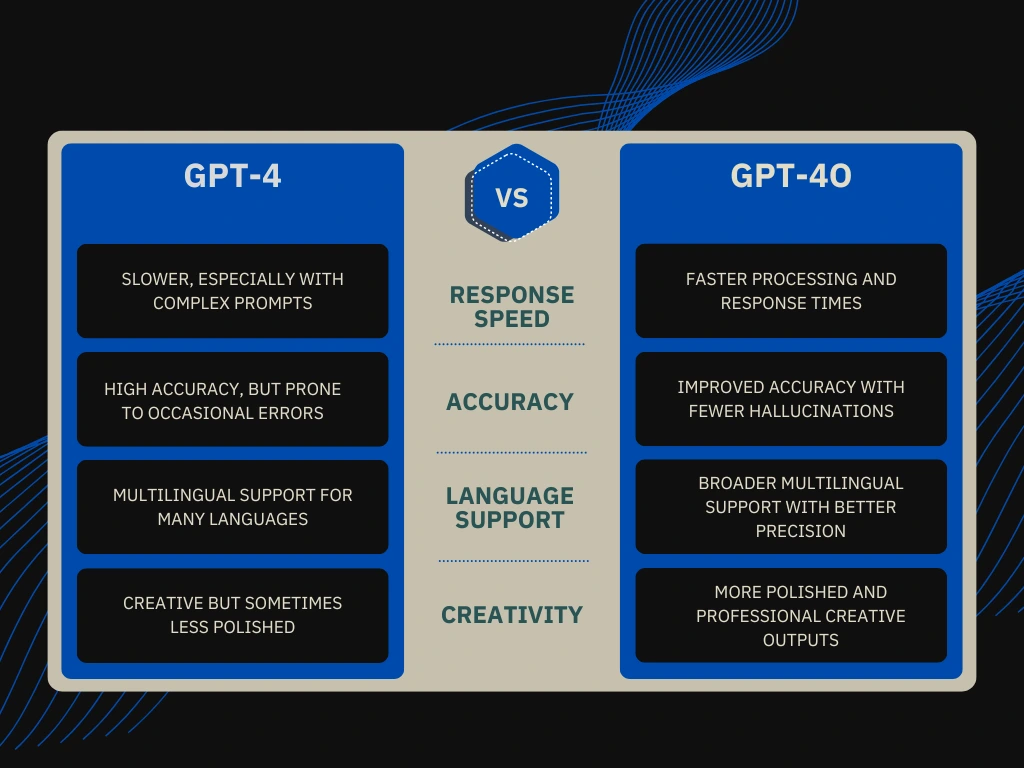
In the fast-evolving realm of artificial intelligence, the leap from GPT-4 to GPT-4o marks a significant milestone, showcasing substantial improvements in AI capabilities. GPT-4, known for its deep reasoning and ability to handle complex prompts with nuanced responses, has set a high standard in the AI community. However, GPT-4o takes this a step further by enhancing accuracy and efficiency, especially in multitasking across various data types including text, visuals, and audio.
GPT-4 excels in producing sophisticated, context-aware responses, particularly in scenarios involving advanced problem-solving and comprehension of intricate instructions. Its prowess in creative writing and style adaptation is notable, often generating content that is rich and detailed. However, GPT-4o extends these capabilities by not only matching but exceeding in areas like multilingual communication, handling a broader array of languages with greater precision, which is a significant leap forward for global AI applications.
Moreover, GPT-4o demonstrates an increased efficiency in processing speed and response quality. While GPT-4 performs well under extended context scenarios, GPT-4o’s ability to maintain conversational continuity and manage longer dialogues or documents showcases its superior token efficiency. This makes GPT-4o not only faster but also more reliable in delivering contextually accurate information without the frequent “hallucinations” or errors seen in earlier models. This progression signifies not just an incremental update but a substantial advancement in how AI models understand and interact with human-like dialogues and complex problem-solving scenarios.
Sure! Here’s the quotation in English exactly as it appears in the source:
“GPT-4o showed a 7% improvement compared to GPT-4 Turbo. Interestingly, in an evaluation we ran last December using the same data, GPT-4 Turbo scored 65%, which was higher than today’s results. We’ll definitely need to analyze this further, but one could assume that GPT-4 Turbo is degrading over time.”
— Vellum.ai
Innovations in AI Creativity: Comparing GPT-4o and GPT-4
When it comes to AI creativity, both GPT-4 and GPT-4o demonstrate impressive capabilities, but key differences emerge when comparing their outputs. To explore these differences, I provided both models with the same prompt: “Generate a short poem in sonnet style and in the love theme.” The resulting sonnets reveal how each version approaches creative writing with unique strengths.
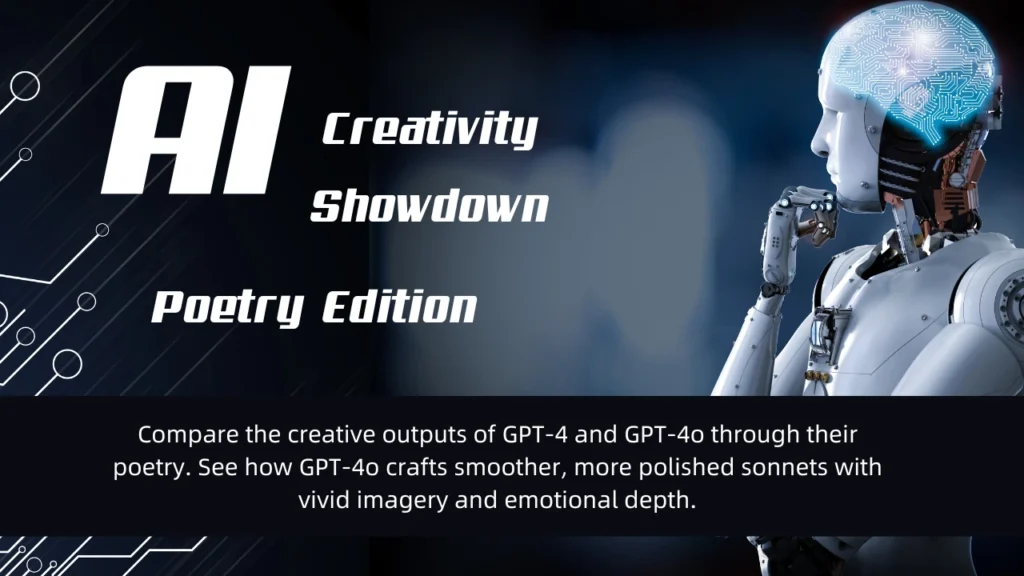
The first poem, “Upon the Dawn of Love’s Sweet Gaze,” was written by GPT-4:
Upon the Dawn of Love’s Sweet Gaze
Within the quiet dawn, love whispers soft,
As shadows flee and daybreak’s blush unfolds.
Through gilded rays, our lifted eyes aloft,
Where heart meets heart, a tender story told.
Each morning light, like paint upon a page,
Colors the world where once was naught but grey.
Thy gaze, an artist’s brush, my soul’s unswage,
Turns darkest night into the brightest day.
Yet love, not always gentle, often wild,
Can shake the roots of what we feel and know.
Still, steadfast stays, when softly it beguiled,
And in its depth, the truest passions grow.
In thy embrace, the world feels less severe,
For every sigh, love’s reasons reappear.
The second sonnet, “In gentle whispers, love’s sweet tune does play,” was crafted by GPT-4o:
In gentle whispers, love’s sweet tune does play
A melody that stirs both heart and mind,
Through fleeting night and softly glowing day,
It binds two souls in ways the stars designed.
The eyes, a mirror, speak of worlds untold,
Where silent dreams and hopes do intertwine,
In warmth, the coldest hearts grow brave and bold,
A spark ignites, where once there was no sign.
Yet love, though soft, can burn with fire bright,
A flame that dances wild but will not cease,
It lights the darkest paths with tender light,
And brings to restless hearts a perfect peace.
For in your eyes, my every truth is shown,
In love, I find a world that’s all my own.
The first poem, “Upon the Dawn of Love’s Sweet Gaze,” written by GPT-4, showcases creativity but occasionally feels less refined in terms of meter and flow. Meanwhile, the second sonnet, “In gentle whispers, love’s sweet tune does play,” crafted by GPT-4o, presents a more polished and professional tone.
Structure and Flow:
GPT-4o’s sonnet maintains a smoother rhythm and more consistent meter, contributing to a better overall flow. In contrast, while GPT-4’s sonnet is creative, some lines feel slightly less refined in their meter, impacting the smoothness of the poem.
Imagery and Depth:
GPT-4o excels with vivid metaphors like “a flame that dances wild” and “a melody that stirs both heart and mind,” evoking strong emotional imagery that is more in line with classic sonnets. GPT-4, though also creative with metaphors like “morning light, like paint upon a page,” offers slightly less intricate phrasing in comparison.
Thematic Clarity:
In terms of thematic clarity, GPT-4o delivers a more continuous exploration of love’s emotional depth, with stronger transitions between the gentleness and power of love. GPT-4, on the other hand, leans more abstract in its imagery, which can be intriguing but less focused in its thematic progression.
In summary, GPT-4o excels in producing more polished, emotionally resonant creative outputs, whereas GPT-4 offers a creative yet slightly less refined response. This comparison highlights how GPT-4o advances AI creativity with smoother structure, richer imagery, and clearer thematic development.
GPT-4 vs. GPT-4o: A Comprehensive Comparison oF Analytical Depth
To test the capabilities of both GPT-4 and GPT-4o, I designed questions that would evaluate how well each model understands complex language, analyzes philosophical concepts, and generates creative responses while explaining scientific processes. These tests helped compare their strengths in handling nuanced topics and producing insightful, well-structured outputs.
The two key questions asked were:
Philosophical Thought Experiment:
“Analyze the statement ‘Artificial Intelligence will never replace human creativity’ from philosophical, technological, and artistic perspectives.”
Environmental Science Query:
“Describe the process of ocean acidification and its effects on marine life. How does this contribute to broader climate change impacts?”
How Each Model Responded
Philosophical Thought Experiment
GPT-4o gave a concise, structured response, clearly outlining the emotional and creative limitations of AI while acknowledging its potential to enhance human creativity. It focused on practical insights, delivering a balanced and straightforward view.
GPT-4 provided a more in-depth analysis, exploring the philosophical implications of AI’s creative limitations. It reflected on whether AI could mimic or collaborate with humans to extend artistic boundaries, offering a comprehensive and nuanced breakdown of creativity.
Analysis:
GPT-4o was practical and easy to follow, ideal for readers looking for quick insights. GPT-4 was more reflective, offering deeper philosophical exploration suited for readers who want a thorough, thought-provoking discussion.
prompt-engineering-ai-models-chatgpt/
Environmental Science Query
GPT-4o explained ocean acidification clearly and simply, making the scientific process easy to grasp for a general audience. It connected the effects on marine life with broader climate impacts without overloading the reader with details.
GPT-4 delivered a more technical and detailed explanation, discussing the chemical reactions and long-term ecological effects of ocean acidification. Its response was ideal for readers seeking a deeper understanding of the science behind the issue.
Analysis:
While GPT-4o provided a smooth, accessible summary, GPT-4 catered to a more specialized audience by diving into the scientific intricacies.
Comparing Responses: Structure, Depth, and Clarity
- Structure and Flow:
GPT-4o maintained a clear, structured format, making its answers easy to follow with concise points.
GPT-4 offered more segmented and detailed responses, sometimes sacrificing immediate clarity for deeper reflection.
- Depth of Analysis:
GPT-4o focused on clarity and practicality, delivering balanced arguments that are emotionally resonant and accessible.
GPT-4 went into greater depth, especially in philosophical queries, making it more suited for users seeking comprehensive exploration.
- Philosophical and Artistic Perspectives:
GPT-4o emphasized that AI can enhance but not replace human creativity, focusing on the emotional connection that drives human innovation.
GPT-4 expanded on this, reflecting on how AI and humans could collaborate creatively, offering a more profound look at the limitations and potential of AI.
Conclusion: Practical vs. Reflective Approach
In summary, GPT-4o excels at delivering concise, practical insights with structured responses, perfect for users seeking clear, straightforward answers. GPT-4 offers a deeper, more reflective analysis, making it ideal for readers who want a more comprehensive exploration of complex topics.
Both models are highly capable, but your choice depends on whether you prefer quick, accessible insights or a thorough, nuanced examination of the subject at hand.
Unlocking New Possibilities: How GPT-4o’s Canvas Transforms User Interaction
When comparing GPT-4 and GPT-4o, the standout difference lies in how users engage with these models. GPT-4 sticks to the classic text-based conversational interface, which is great for straightforward dialogue. But GPT-4o introduces Canvas, a game-changing visual workspace that redefines collaboration, especially for projects involving writing or coding. With Canvas, you’re not just having a conversation—you’re working side by side with the AI. You can easily highlight sections of your work, get instant inline feedback, and make real-time edits without switching windows. It’s a far cry from the typical back-and-forth of chat, offering a more immersive, context-aware environment.
What really sets Canvas apart is the level of control and flexibility it gives users. You decide how you want the AI to assist—whether that’s adjusting the complexity of language, fine-tuning the clarity of your writing, or suggesting targeted edits. You’re still steering the ship, but with Canvas, you can also track different versions of your work, making it perfect for iterative tasks like coding or large-scale document revisions. In essence, GPT-4o’s Canvas evolves ChatGPT from being just a conversational assistant to becoming a powerful, collaborative editor, designed to handle complex, multi-step projects with ease.
FAQ
1.What is the difference between GPT-4 and GPT-4o?
GPT-4o, also known as GPT-4 Turbo, builds upon the capabilities of GPT-4 by offering enhanced speed, accuracy, and efficiency, particularly in multitasking and handling complex data types. It processes information faster, maintains conversational continuity better, and is less prone to errors or “hallucinations” compared to GPT-4.
2.Is ChatGPT-4 O free?
If you’re not keen on paying a monthly subscription fee, there’s good news for ChatGPT users. With the rollout of GPT-4o to free users, many of the features that were previously only available through a paid Plus subscription are now accessible without any cost. This means you can take advantage of GPT-4o’s enhanced capabilities, such as faster response times, improved accuracy, and better handling of complex queries, without having to invest in a premium plan. The availability of these advanced features for free makes GPT-4o a great option for those looking for high-quality AI assistance without the recurring expense.
3.What is the limit of GPT-4o free?
Free tier users can currently access GPT-4o but are limited to 10 messages per day. Once this limit is reached, ChatGPT will automatically switch users back to GPT-3.5 for continued usage. These limitations are intended to manage server load while still providing access to advanced features for non-subscribers. To access GPT-4o without these restrictions, users can opt for a paid subscription, like ChatGPT Plus, which offers higher message limits
4.How does GPT-4o perform in handling complex queries?
GPT-4o provides concise and structured responses to complex queries, making it ideal for users who prefer quick insights. In contrast, GPT-4 offers more in-depth, reflective responses, which are better suited for readers seeking comprehensive exploration of topics like philosophy and science.
5.Is GPT-4o better than GPT-4?
Yes, GPT-4o (also known as ChatGPT-4 Turbo) is considered an enhanced version of GPT-4, offering significant improvements in speed, accuracy, and efficiency. GPT-4o excels in multitasking, processing diverse data types like text, visuals, and audio more effectively than GPT-4, and maintains conversational continuity over longer dialogues. It also provides more contextually accurate responses with fewer errors or “hallucinations,” making it a better choice for users who need faster and more reliable outputs.


